
How Mosquito Barrier Spray Works and How Long It Lasts
If your neighbor’s yard feels usable in July and yours does not, a barrier treatment is usually the difference. Mosquito Mike treats homes across Massachusetts, Rhode Island, and the Raleigh Triangle, and barrier spray is the backbone of every program we run. This guide covers what the treatment actually is, what is in ours, where it goes, and — the question everyone asks — how long it keeps working. Where a claim here rests on research or on a product label, the source is linked beside it.
What Barrier Spray Is
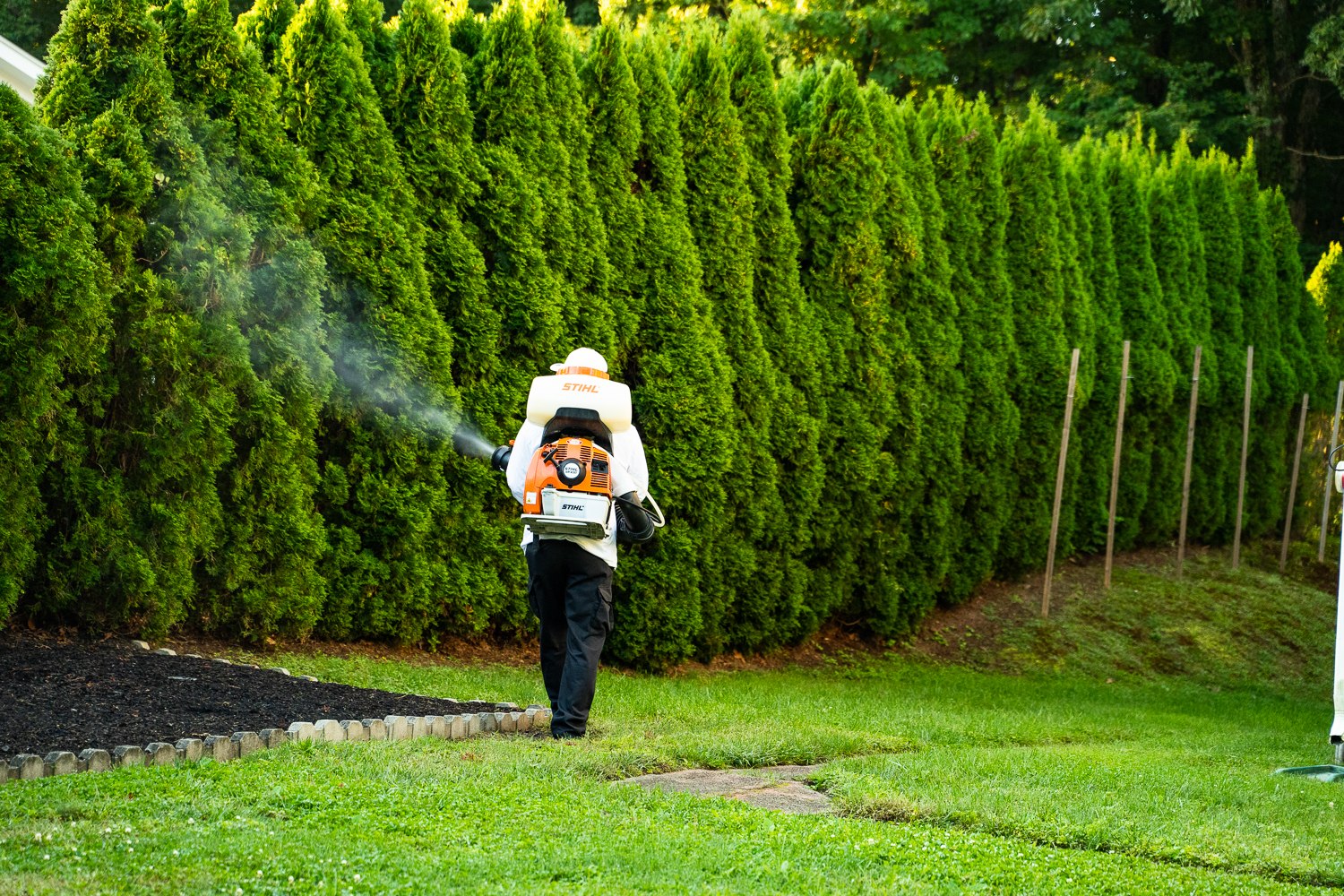
Barrier spray is a professional liquid treatment applied by a licensed technician to the foliage, shrub lines, ground cover, lawn, and perimeter areas of a property. It is not a fogger, and it is not a permanently installed system. The idea is straightforward: treat the surfaces where mosquitoes and ticks spend their time, so the ones that land there are exposed to the treatment rather than to you.
That word barrier actually undersells it. The treatment does not just draw a line around the yard — it works everywhere mosquitoes rest, across the whole property.
How It Works: Contact Kill Plus a Surface Deposit
There are two mechanisms, and understanding the second one explains almost everything else on this page.
The first is contact. Bifenthrin, the active ingredient in our conventional treatment, is a pyrethroid. On contact it disrupts the insect nervous system — a mosquito or tick that touches a treated surface while the treatment is active takes the dose directly.
The second is residual. Once the spray dries, the active ingredient stays on the leaf, bark, and other treated surfaces as a deposit. Insects landing on those surfaces afterward are still exposed. That residual window is what makes a barrier treatment a program rather than a single event.
Here is the part most companies never explain: a barrier treatment is a contact treatment, and contact treatments stay on the plant surface — they are not absorbed into the plant or moved through it. The product sits on the outside. It does not travel into the leaf, and it does not move into anything the plant grows later.
Every consequence in the rest of this article follows from that one fact.
What Mosquito Mike Applies
Conventional program. Our conventional treatment is built on bifenthrin, a professional-grade pyrethroid, mixed with garlic and a sticking agent — additives that help the treatment cling to foliage and keep working longer between visits. Its EPA-registered label directs application to the entire area where pest contact may occur — not spot treatments — and calls for higher spray volumes in heavy leaf litter or dense ground cover, which matches how a New England or Triangle yard is actually built.
All-natural program. Our all-natural treatment is a plant-oil formula built on citronella, peppermint, and cinnamon oil, also mixed with garlic and a sticking agent. It is a minimum-risk formula — a federal category for pesticides made entirely from ingredients the EPA has determined pose minimal risk, which are exempted from individual federal registration (some states still require their own registration).
Source: US EPA — Conditions for Minimum Risk Pesticides
Which program a property runs is a choice you make, and the two behave differently on the leaf. That difference is covered below.
Where the Spray Goes: the Whole Property, for a Reason
We treat the full property — the lawn as well as the perimeter — and there is real strategy behind that. Mosquitoes concentrate in shaded, sheltered vegetation: the undersides of broad-leaved shrubs, dense ground cover, the margins along fence lines, and the edge where lawn meets woods. Treating the thickets, shrubs, and trees along the perimeter of a yard knocks down the population resting there.
Source: NC State Extension — Mosquito Control Around Homes and in Communities
So your technician gives that resting habitat the most attention — under canopies, into the lower few feet of dense plantings, along wooded edges — and treats the open ground too. Two reasons the whole property matters. First, ticks ride in on host animals, and an animal crossing your yard does not stay politely at the property line — treating the lawn covers what gets dropped inside it. Second, a perimeter-only application can leave pests active inside the treated ring — we would rather clear the yard than fence them in.
And harborage is not only the property line. The bushes and trees inside a yard, the plantings around the house, and the shaded vegetation around a deck or pool are all resting habitat, and all of it gets attention on a visit.
How Long Does Barrier Spray Last?
There is no single honest number — and any company that gives you one is quoting marketing rather than data. Here is what the published field research actually shows, and what we do about it.
Barrier treatments work. In a suburban residential trial, bifenthrin barrier applications cut Aedes albopictus mosquito bites by 85%.
Source: Trout, Brown, Potter and Hubbard 2007 — Journal of Medical Entomology 44(3)
But the protection is strongest early. In a study that applied bifenthrin to five common landscape plants, knockdown was highest the day of treatment and seven days after — and how well the residue held beyond that depended heavily on which plants were growing in the yard.
Source: Doyle, Kline, Allan and Kaufman 2009 — Journal of the American Mosquito Control Association 25(2)
A review covering 44 barrier-treatment studies published between 1944 and 2018 found the same pattern at scale: residual efficacy varied widely across products and conditions, driven by formulation type and by new leaf growth giving mosquitoes untreated places to rest.
Source: Stoops, Qualls, Nguyen and Richards 2019 — Environmental Health Insights 13
Worth knowing: our own product label makes no duration promise for mosquitoes. It tells the applicator to retreat when there are signs of renewed activity — because the real number depends on the yard.
Plant-oil products are a different category and the research on them is thinner. In CDC-published testing of minimum-risk plant-oil products, those applied by low-pressure spraying held their protection for a shorter window than conventional products — and how the product is applied appeared to matter as much as which oils are in it. This is a live area of research rather than a settled one — and one more reason consistent scheduling matters most on a plant-oil program.
Source: Eisen 2024 — Emerging Infectious Diseases 30(1), CDC
The practical answer: a well-applied barrier treatment is strongest in the first days and weeks, and rain, sun, and new growth wear it down from there — on a different clock in every yard. That is why we treat on a schedule instead of selling a number: the goal is protection that never gets the chance to fade.
And here is the number we track instead, because it is ours and it is counted: about 1 in 100 of our visits needs an unscheduled return before the next scheduled treatment. The industry average is nearly 6 in 100, per the 2026 PCT State of the Mosquito Control Market Report. Consistent scheduling is what that gap looks like in practice.
What Wears a Treatment Down
Three things, in order.
Rain. This is the big one. Regardless of treatment method or plant species, rainfall was the most important factor in removing bifenthrin from the leaf surface and decreasing knockdown. Degradation of bifenthrin efficacy was slowest in sites protected from rain and sun.
Source: Allan, Kline and Walker 2009 — Journal of the American Mosquito Control Association 25(3)
Sun. In the same study, placing plants in full sunlight significantly reduced efficacy compared with plants placed in shade. This is one reason a shaded shrub interior — where mosquitoes rest anyway — tends to hold a treatment longer than an exposed surface.
New growth. Because the product sits on the leaf surface and is never taken up by the plant, every leaf that opens after the technician leaves is untreated. In June and July, a hedge can put out a lot of brand-new, completely untreated resting habitat in a few weeks. This is exactly the mechanism the 44-study review identified as a driver of efficacy loss.
Source: Stoops, Qualls, Nguyen and Richards 2019 — Environmental Health Insights 13
There is also a fourth factor that has nothing to do with chemistry: mosquitoes keep being produced. The mosquito life cycle typically takes up to two weeks, but depending on conditions it can range from four days to as long as a month.
Source: US EPA — Mosquito Life Cycle
Our mix fights back — the garlic and sticking agent are in the tank precisely to help the treatment cling and last longer — but rain, sun, and new growth eventually win in every yard. Which is exactly why the next section exists.
How Often We Treat
This is why we treat about every two weeks: we are on your property twice a month — spotting new standing water, fresh growth, and problem areas between applications — and the experience stays consistent all season. Tri-weekly and seasonal plans cover the same ground on a longer cycle.
Ready to get your yard on a schedule? Get your instant quote.
What Barrier Spray Does Not Do
Straight answers here are worth more to you than promises.
1. It does not seal your property — which is exactly why we never treat it like a fence line. Mosquitoes and ticks can move back in from surrounding untreated areas, and ticks ride in on host animals. That is the reason we treat the whole property instead of just the perimeter: coverage everywhere beats a ring around the edge.
Source: NC State Extension — Mosquito Control Around Homes and in Communities · Source: University of Maryland Extension — Controlling Mosquitoes
2. It does not replace getting rid of standing water. Mosquitoes breed in standing water, so removing it around your home reduces the number of new mosquitoes there. Modifying or eliminating breeding sites is the long-term solution to severe mosquito problems, and pesticide applications are only a short-term solution to long-term nuisance mosquito problems. Clogged gutters, flowerpot saucers, tarps, buckets, and low spots that hold rain are the usual culprits — and it is why our technicians dump what they find and can place larvicide pucks where water cannot be dumped.
Source: University of Maryland Extension — Controlling Mosquitoes · Source: NC State Extension — Mosquito Control Around Homes and in Communities
3. It does not last a fixed number of days. See the duration section above. Rain, sun, and new growth all move the number, and they move it differently in every yard — which is what the schedule is for.
4. It does not follow you off the property. A barrier treatment treats your yard. The protection ends at your property line.
Getting the Most Out of a Treatment
Mow before the visit, not right after. Because the product is a surface deposit that is never absorbed into the plant, cutting treated foliage removes the deposit along with the clippings. Mowing first also opens up dense growth so the application reaches into it.
Move what you do not want treated. Toys, pet bowls, and furniture cushions are easy to bring in beforehand.
Close the windows and doors, bring everyone inside — pets included — and unlock the gate. That is the entire prep list your technician needs from you, and yes, the air conditioning can stay on.
Tip out standing water you know about — saucers, buckets, tarps, kiddie pools — before the technician arrives. Your technician dumps what they find on the arrival walk-through too, but nobody knows a yard's hiding spots like the person who lives there.
Point out the problem spots. A damp shaded corner, a dense ornamental bed, a fence line against a wooded lot. Specific input makes for a more targeted application.
Keep people and pets off treated surfaces until the spray has dried. That is our conventional product's label instruction, verbatim: do not allow people or pets on treated surfaces until spray has dried. Your technician will confirm timing at each visit. Once dry, the yard is ready for normal use.
What Happens on Treatment Day
A standard barrier spray visit — the recurring mosquito and tick treatment this article covers — runs the same way whether your program is conventional or all-natural.
You hear from us twice before we arrive. A text the night before, and another when your technician is on the way — typically about 45 minutes out. Prefer email or an automated call instead? We can set up any of them, or all three.
You do not need to be home. What we do need: everyone inside — pets included — windows and doors closed, and the gate unlocked. Staying home is completely fine, and so is leaving the air conditioning running; that question comes up more than you would think.
The visit starts with a walk-through. Your technician checks that the yard is clear to treat, dumps any standing water they find along the way, and plans the application around what the property actually looks like that day.
Then the treatment, in a deliberate order. The perimeter first — that is the barrier going up — then around the house, then the entire lawn, steering clear of vegetable gardens and anything in bloom, dandelions and clover included. Where standing water cannot simply be dumped, we can place larvicide pucks that keep working on breeding sites between visits. And for severe mosquito or tick pressure, a booster can be added to a treatment or a retreatment.
And you know when it is done. A door hanger, a yard sign if you have okayed one, and a text confirming your treatment is complete.
Barrier Spray Compared With a Misting System
These get confused, and they are not the same thing. A barrier treatment puts a licensed technician on your property on a schedule — someone who walks the yard, sees what changed since last time, dumps standing water, and applies where the pests actually are that week. Nothing is installed on your property.
A misting system is hardware. EPA describes outdoor residential misting systems as spray nozzles mounted around the perimeter of a home — in the lawn or landscaping, or on parts of the house or fence — connected by tubing to a supply of insecticide, turned on by a timer, a remote controller, or a switch.
Source: US EPA — Mosquito Misting Systems
The practical difference is who decides when product goes out — and whether anyone is looking at the yard when it does. A timer sprays the same spots on the same schedule regardless of weather, growth, or need. A scheduled visit puts trained judgment on the property every time.
Bees and Other Pollinators
We plan every application around pollinators, and it shows up in the practices: technicians treat resting habitat — shaded foliage, ground cover, wooded edges — and never spray vegetable gardens or anything in bloom, dandelions and clover included. Careful timing and targeting are how a professional treatment and a healthy pollinator population share the same yard.
If you keep hives or maintain a pollinator planting, tell us before the first visit so the application can be planned around them.
Ticks Run on a Different Clock
Mosquito timing and tick timing are not the same problem, and treating them as one is a common mistake.
For ticks, correct seasonal timing matters more than interval. Our conventional product's label directs that deer ticks, which have a four-stage life cycle spanning two years, be treated in the late fall and/or early spring to control adult ticks on brush or grass above the soil surface, and in mid to late spring to control the larvae and nymphs living in soil and leaf litter. American dog ticks call for treatment from mid spring to early fall.
That guidance is why winter tick control is a separate service rather than an add-on to summer spraying — the late-fall and early-spring windows the label names fall outside mosquito season entirely. On the residual side, CDC-published testing found products based on synthetic pyrethroids suppress host-seeking blacklegged ticks for at least six weeks — a very different profile from the mosquito picture.
Source: Eisen 2024 — Emerging Infectious Diseases 30(1), CDC
If ticks are the main concern on your property, tick control is scheduled around those windows.
Get your yard on a schedule that fits it.
Mosquito Mike provides professional mosquito control across Massachusetts, Rhode Island, and the Raleigh Triangle, with conventional and all-natural programs. Get your instant quote.
Frequently Asked Questions
How long does mosquito barrier spray last?
There is no single number, because it depends on your plants and your weather. Field research shows barrier treatments cut mosquito bites sharply, with one suburban trial measuring an 85 percent reduction, and protection is strongest in the first days and weeks after application. Rain, sun, and new leaf growth wear it down from there, on a different clock in every yard. That is why we treat on a schedule: protection that never gets the chance to fade.
How does mosquito barrier spray work?
It works two ways. On contact, the active ingredient disrupts the insect nervous system. After the spray dries, it stays on leaves, bark, and other treated surfaces as a deposit, so insects landing there later are still exposed. Technicians treat the whole property, with extra attention on the shaded foliage, ground cover, and wooded edges where mosquitoes rest during the day.
What is in Mosquito Mike barrier spray?
Our conventional treatment is a professional bifenthrin product mixed with garlic and a sticking agent that helps it hold onto foliage. Our all-natural treatment is a plant-oil formula built on citronella, peppermint, and cinnamon oil, also mixed with garlic and a sticking agent. The all-natural formula is a federal minimum risk category pesticide, made from ingredients EPA classifies as posing minimal risk.
Does rain wash away mosquito barrier spray?
Rain is the single biggest factor. Research on bifenthrin applied to landscape vegetation found that regardless of treatment method or plant species, rainfall was the most important factor in removing the product from the leaf surface and reducing knockdown, and that degradation was slowest at sites protected from rain and sun. If a significant storm arrives shortly after a treatment, contact us and we will advise on timing.
When can kids and pets use the yard after a treatment?
Stay off treated surfaces until the spray has dried. That is the product label instruction: do not allow people or pets on treated surfaces until spray has dried. Your technician will confirm timing at each visit, since drying depends on temperature, humidity, and how dense the treated vegetation is. Once dry, the yard is ready for normal use.
How often should a yard be treated?
Treating about every two weeks means we are on your property twice a month, spotting new standing water, fresh growth, and problem areas between applications. Tri-weekly and seasonal plans cover the same ground on a longer cycle.
Does barrier spray harm bees?
We plan every application around pollinators. Technicians treat the resting habitat mosquitoes use, such as shaded foliage, ground cover, and wooded edges, and never spray vegetable gardens or anything in bloom, dandelions and clover included. If you keep hives or maintain a pollinator planting, tell us before the first visit so the application can be planned around them.
What is the difference between barrier spray and a mosquito misting system?
A barrier treatment is applied by a licensed technician on a scheduled visit, with no equipment installed on your property. EPA describes outdoor residential misting systems as spray nozzles mounted around the perimeter of a home, connected by tubing to a supply of insecticide, and turned on by a timer, a remote controller, or a switch. The insecticides used in them most often contain pyrethrins and permethrin.
Ready to take your yard back?
Get an instant quote for your property in about a minute.
Get Your Free QuoteOr call (844) 750-6453

Ready to take your yard back?
Get an instant quote for your property in about a minute.