Is My Town Being Sprayed for Mosquitoes? The Massachusetts and Rhode Island Guide
Every September a version of the same question starts finding me — at the office, over a fence, and in the search logs of our own website, where people from a dozen different towns type “are they spraying for mosquitoes” with their town’s name attached. Some people ask because they want the spraying. Some ask because they want to keep it away from their garden. Either way, the answer is genuinely confusing, because “they” is not who most people think. When we published our EEE and West Nile update, I promised a full guide to how public mosquito spraying works across our service area. This is that guide: who runs it, how to check your own street, how to ask for it, how to opt out of it, what is actually in the trucks, and where a company like mine fits in — and where we do not.
Who Actually Sprays in Massachusetts
The trucks almost never belong to your town hall. Public mosquito spraying in Massachusetts is run by regional mosquito control projects — public agencies, organized mostly by county, overseen by the State Reclamation and Mosquito Control Board inside the Department of Agricultural Resources. There are eleven of them, and each one answers to the cities and towns that belong to it. Your local board of health works with the project on what happens inside your town line, which is how one town ends up with truck runs the same week the next town over hears nothing.
Here is the part that surprises people: membership is town by town, not automatic. A town that never joined a project has no spray program to call, no matter what county it sits in. That is not a technicality — during the 2024 EEE emergency, the state’s own guidance noted that only two of the seven southern Worcester County towns at high or critical risk actually belonged to the district; the other five had no trucks of their own and needed the state to step in. If you have ever wondered why your cousin’s town gets sprayed and yours never does, this is usually the whole answer.
Source: Mass.gov — Mosquito Control Projects and Districts
Eight of the eleven projects cover the ground we work every day. The state’s directory carries every member town; here is the short version, with the towns our customers ask from most:
- Bristol County Mosquito Control Project — the 20 cities and towns of Bristol County, including Fall River, New Bedford, Somerset, Swansea, and Taunton. (508) 823-5253.
- Plymouth County Mosquito Control Project — 28 towns, including Plymouth, Wareham, Brockton, Marshfield, and Middleborough. (781) 585-5450, plymouthmosquito.org.
- Norfolk County Mosquito Control District — 25 towns, including Bellingham, Franklin, Needham, and Quincy. (781) 762-3681, norfolkcountymosquito.org.
- Central Massachusetts Mosquito Control Project — the biggest roster in our area, 44 communities including Holliston, Lowell, Chelmsford, Dracut, Billerica, and Worcester. (508) 393-3055, cmmcp.org.
- East Middlesex Mosquito Control Project — 28 communities west and northwest of Boston, including Weston, Newton, Waltham, Cambridge, Framingham, and Lexington. (781) 899-5730.
- Northeast Massachusetts Mosquito and Wetlands Management District — 32 municipalities on and around the North Shore, including Andover, Methuen, and Haverhill. (978) 352-2800, nemassmosquito.org.
- Suffolk County Mosquito Control Project — exactly two members, Boston and Chelsea, run from the same office as East Middlesex.
- Cape Cod Mosquito Control Project — all fifteen Barnstable County towns. (508) 775-1510, ccmcp.net.
How to Check If Your Street Is on a Spray List
The projects do not spray in secret — they announce. Before trucks roll, each project posts where they are going: Bristol County published the town list for its September 11 run days ahead, and Plymouth County posts its upcoming spray routes on its website through the season. So the fastest honest answer to “is my town being sprayed tonight” is: find your project in the state directory above, and check its website or call its office. It is a five-minute habit that beats any rumor on a neighborhood Facebook group.
The second thing worth checking is your town’s current disease risk, because that is what drives the late-season spraying decisions. The state posts an EEE and West Nile risk level for every single city and town in Massachusetts, updated through the season — that page is the source I trust over any headline, including our own articles. Rhode Island announcements work differently: they come as joint advisories from the Department of Environmental Management and the Department of Health.
Source: Mass DPH — Massachusetts Arbovirus Update (risk level by city and town)
Can You Ask Them to Spray Your Street?
Yes — this is the part almost nobody knows. If your town belongs to a project, you can request spraying for your area during the season, by phone or through the project’s website. It is a public service of the member communities; there is no company and no invoice involved. Our crews meet people every summer who have lived for years with a mosquito problem and never knew the county already had a truck they could ask for.
The catch is the calendar. Spray seasons wind down when overnight temperatures drop, and the request windows close with them. As I write this in late September 2026, that has already happened across our area: Bristol County made its final scheduled run on September 11 and has ended spraying for the season, Norfolk County has ended spraying “due to low numbers of requests and mosquitoes in our traps,” East Middlesex has concluded for the year, Central Massachusetts has stopped accepting residential requests, and Plymouth County has closed residential requests while noting that disease-response spraying continues as needed. Requests open again when the trucks come back out in late spring.
Source: Bristol County Mosquito Control Project — 2026 season notes
Notice what Bristol County said on the way out, though. The same notice that ended the season reminds residents to keep protecting themselves against mosquitoes until the first hard frost. The trucks stop in mid-September because their method needs warm nights — an overnight mist only reaches mosquitoes that are out flying, and cool evenings keep them grounded. That is a limit of night spraying, not of mosquito control: daytime barrier treatments like ours go on the foliage where mosquitoes rest and keep working right through this stretch of the season. Rhode Island’s health department puts the real end of the season at the first heavy frost, usually around the end of October.
Source: RI Department of Health — Mosquitoes
Can You Opt Out?
Also yes. Massachusetts has a formal exclusion process for property owners who do not want wide-area pesticide applications on their land — beekeepers, organic growers, or anyone who simply prefers it. Under the state regulation, you file the request with the Department of Agricultural Resources, by first-class mail or its online form. You can file at any time of year, the exclusion takes effect 14 days later, and — this is the part people miss — every exclusion expires on December 31 and has to be renewed each year. One more detail worth knowing: this state process replaced the old certified-letter-to-your-town-clerk route, so if you filed the old way years ago, your request does not carry over.
The projects also publish a marking method so crews can see excluded properties from the road: white plates at least nine inches across, marked “No Spray” in permanent marker, posted every 50 feet along your road frontage within five feet of the road. If you drive our towns in the summer, you have probably seen these on fence posts and never known what they were.
Source: MDAR — Exclusions from Wide Area Pesticide Applications
What Is Actually in the Trucks
A public spray run is an ultra-low-volume application: the truck moves through in the evening and overnight hours — operations can run from early evening to roughly 4:30 in the morning — releasing a very fine mist that kills adult mosquitoes it contacts, timed for when the mosquitoes that matter are flying. The product is public record, named on each operation’s notice. For state-level operations, Massachusetts and Rhode Island both name the same one: Anvil 10+10, which contains sumithrin and piperonyl butoxide. The state’s guidance describes both ingredients as breaking down with exposure to light and air, with a half-life of less than one day in the air and on plants; it also answers the practical questions — pets can come indoors during a pass, small ornamental fishponds can be covered overnight, and garden vegetables need nothing beyond the rinse you would give them anyway.
Source: Mass DPH — Mosquito Control and Spraying FAQ
I said this in our article on whether mosquito spraying works and it applies double here: whoever is spraying anything near your property — a county truck or a company like mine — you are entitled to know exactly what is being applied. The notices name the product. The labels are public. Read them, and ask questions of anyone who gets cagey about the answer.
Rhode Island Runs a Different Playbook
Rhode Island does not run county spray trucks the way Massachusetts does. The state’s program, coordinated by the Department of Environmental Management, is built on going after mosquitoes before they can fly: crews trap and test mosquitoes statewide every week from June until the first frost, and the main control tool is larviciding — helicopters dropping granular Bti, a naturally occurring bacterium, into swamps and breeding areas so the larvae never become biting adults. DEM notes the material does not affect honey bees. Spraying for adult mosquitoes is reserved for times when disease risk climbs, and it is rare: the state’s last aerial operation was in 2019, when parts of 21 communities were treated over three nights.
Source: RI DEM — Mosquito Abatement Coordination
So if you are in Cranston or Smithfield wondering why you never see a spray truck: that is the design. Your swamps are being treated from the air in the larval stage, and adult spraying waits for a genuine disease trigger — announced through those DEM and health department advisories when it happens.
What About Raleigh?
Our North Carolina customers can save themselves the search: Wake County says it plainly on its own website — “Wake County does NOT operate a spraying program.” The county’s public health department focuses on prevention, mostly the standing-water work, and takes mosquito complaints by phone. There is no county truck coming, in Raleigh or Cary or Garner. In the Triangle, if a yard is getting treated for mosquitoes, a private company is doing it. If you live outside Wake County, your own county health department’s website will tell you whether anything public exists where you are.
Source: Wake County — Mosquito Prevention
The Trucks and Your Yard Are Two Different Jobs
Now the question underneath all the others: if the county sprayed my street Tuesday night, is my yard set? No — and it is worth being precise about why, because the confusion runs in both directions. A public truck run is a neighborhood-scale knockdown: an overnight mist that kills the adult mosquitoes flying during those hours, aimed at pushing down disease risk across an area. It is real, it is useful, and I am glad it exists. But nothing from that pass keeps working on your property afterward, it was never aimed at your backyard specifically, and it does nothing at all about ticks.
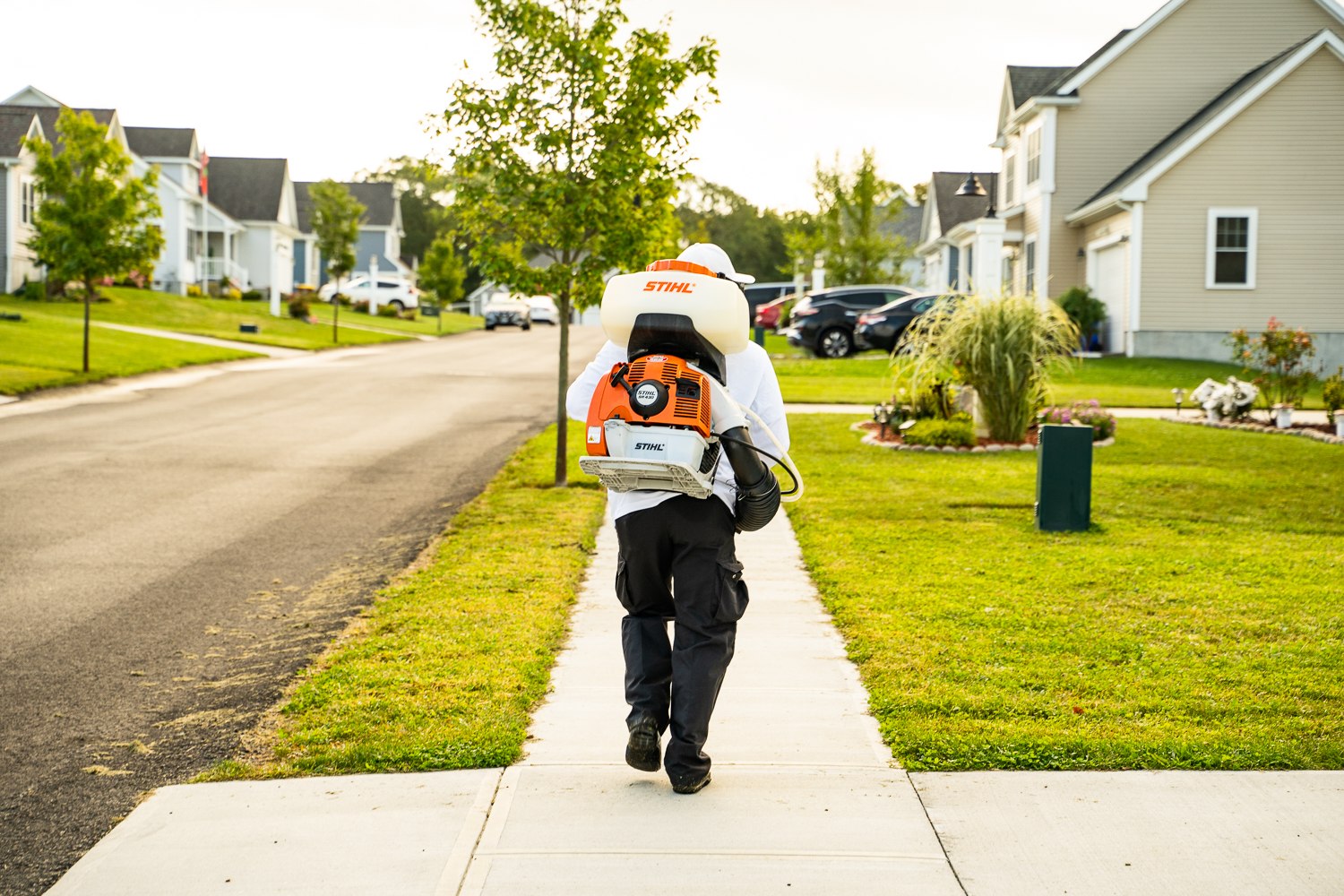
A yard program is the other job: a barrier treatment applied to the vegetation on your own property — the shrubs and shaded leaves where mosquitoes rest all day — refreshed about every two weeks so the protection is there every evening, not just the night after a truck went by. Ours covers mosquitoes, ticks, and fleas, and comes with complimentary resprays between scheduled treatments as part of the satisfaction guarantee. The public program protects the town; a yard program protects your yard. Neither one replaces the other, and nobody selling you either one should pretend it does.
And between now and the frost, do the free things no matter what: dump the standing water after every rain, keep the screens tight, and use repellent at dusk. The counties, the state, and every article we have written agree on that list. If you also want your own yard covered for this last stretch of the season — the stretch the spray trucks have already gone home for — that is the job we are built for.
Related Reading
- EEE and West Nile in Massachusetts and Rhode Island: What Is Actually Going On Right Now — the 2026 numbers behind this year’s spraying decisions, and how worried to actually be.
- Does Mosquito Spraying Actually Work? — the evidence on what professional spraying delivers, and its honest limits.
- How Mosquito Barrier Spray Works and How Long It Lasts — what a property treatment actually does on the foliage, and the research on how long it holds.
The short answer: the county protects the town, and your yard is your own job — now you know who does which.
Mosquito Mike provides mosquito control across Massachusetts, Rhode Island, and the Raleigh Triangle, with traditional and all-natural programs and complimentary resprays as part of the service guarantee. Get your instant quote.
Frequently Asked Questions
Who sprays for mosquitoes in Massachusetts?
Regional mosquito control projects — public agencies organized mostly by county, overseen by the State Reclamation and Mosquito Control Board. There are eleven across the state, each serving its member cities and towns, and your local board of health works with the project on control decisions. Membership is town by town, so one community can have a full truck program while the next town over, which never joined, has none at all.
How do I find out if my town is being sprayed for mosquitoes?
Find your regional project on the state’s Mosquito Control Projects and Districts page, then check that project’s website or call its office — projects announce where trucks are going before each run, and several post upcoming routes during the season. For disease risk, the Massachusetts arbovirus update page posts a current EEE and West Nile risk level for every city and town. In Rhode Island, spraying announcements come as joint DEM and Department of Health advisories.
Can I request mosquito spraying from my county?
In Massachusetts, yes — residents of member towns can ask their regional project to spray their area during the season, by phone or through the project’s website, as a public service. The window closes as fall arrives: by late September 2026 the projects in our area had ended residential requests for the year, though disease-response spraying continues where needed. Requests reopen when the trucks return in late spring.
Can I opt out of town mosquito spraying in Massachusetts?
Yes. Under 333 CMR 13.03, you file an exclusion request with the Department of Agricultural Resources by first-class mail or its online form — not with your town clerk, which was the old process. Requests can be filed any time of year, take effect 14 days after they are made, and every exclusion expires on December 31, so it must be renewed annually. Projects also publish a marking method: white plates at least nine inches across marked No Spray, posted every 50 feet along your road frontage.
What do the trucks spray for mosquito control?
Public operations use ultra-low-volume adulticides — a very fine overnight mist that kills adult mosquitoes on contact. For state-level operations, Massachusetts and Rhode Island both name Anvil 10+10, containing sumithrin and piperonyl butoxide; the state’s guidance describes both as breaking down in light and air with a half-life of under a day on plants. Every operation’s notice names the exact product being applied, and the product label is public record.
Does Rhode Island spray neighborhoods the way Massachusetts does?
Not usually. Rhode Island’s program, coordinated by the Department of Environmental Management, leans on larviciding: helicopters drop granular Bti, a naturally occurring bacterium, into swamps and breeding habitat so larvae never become biting adults. Spraying for adult mosquitoes is reserved for elevated disease risk — the state’s last aerial operation was 2019 — and gets announced through joint DEM and health department advisories.
Is there public mosquito spraying in the Raleigh area?
No. Wake County states on its own website that it does not operate a spraying program; its public health department focuses on prevention and takes mosquito complaints by phone. There is no Massachusetts-style county spray truck in the Triangle — if a yard in Raleigh, Cary, or Garner is being treated, a private company is doing it. Outside Wake County, check your own county health department’s mosquito page for what exists locally.
Does town spraying replace a yard mosquito treatment program?
No — they are different jobs. A public truck run is an overnight, neighborhood-scale knockdown of flying adult mosquitoes, aimed at disease risk; nothing from it keeps working on your property afterward, and it does nothing about ticks. A yard program applies a barrier treatment to the vegetation where mosquitoes rest on your own property and refreshes it on a schedule. The public programs themselves remind residents to keep up personal protection until the first hard frost.
Ready to take your yard back?
Get an instant quote for your property in about a minute.
Get Your Free QuoteOr call (844) 750-6453

Ready to take your yard back?
Get an instant quote for your property in about a minute.