
EEE and West Nile in Massachusetts and Rhode Island: What Is Actually Going On Right Now
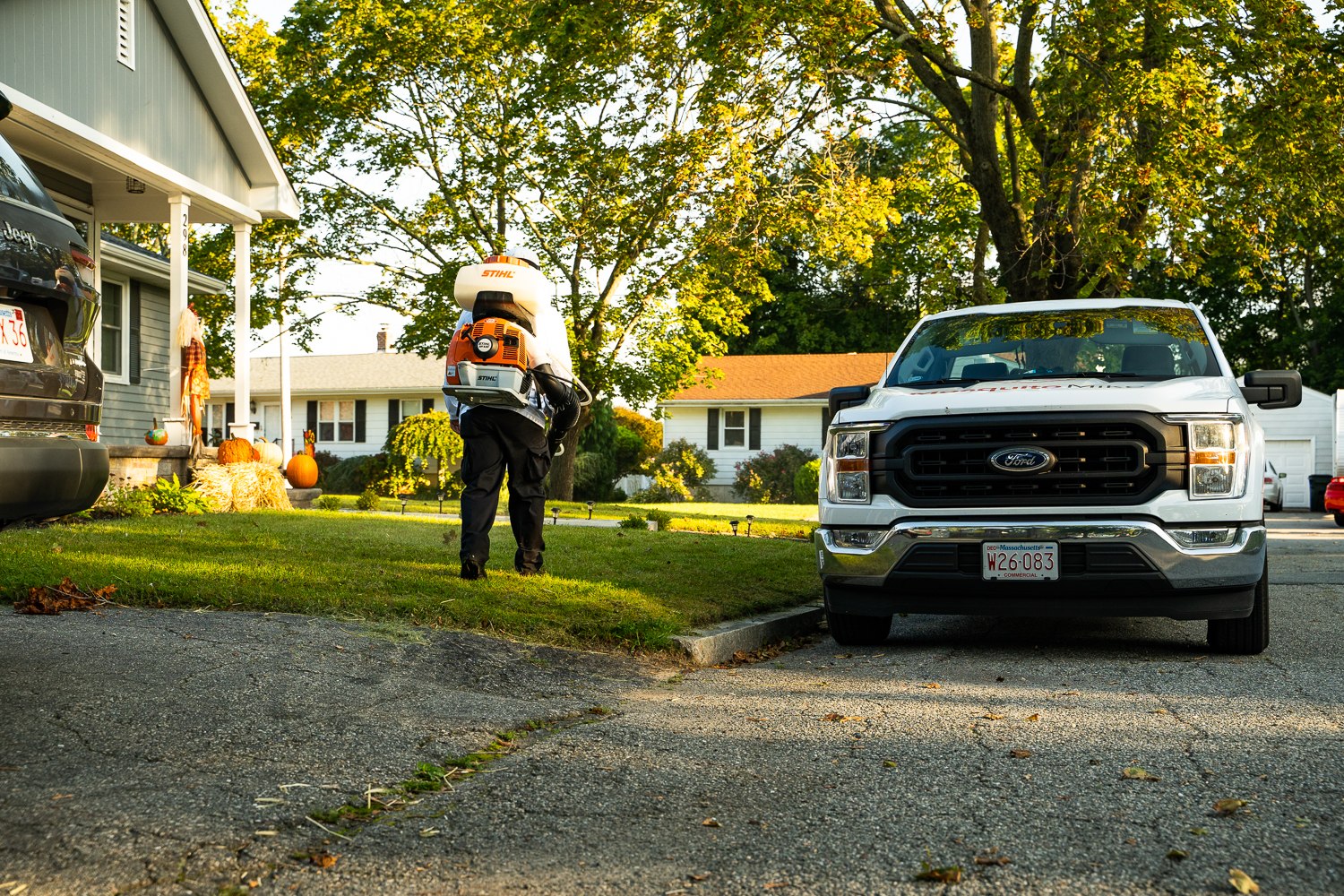
On Friday night, September 11, the county spray trucks were scheduled through seven towns in our corner of Massachusetts: Fall River, Easton, Fairhaven, Mansfield, North Attleborough, Rehoboth, and Seekonk. Our office is in Fall River, so this was not an abstract news item for us — those routes run past our own front doors. And that Friday run was not a routine one, for a reason most people have not heard yet: it was the Bristol County Mosquito Control Project’s final scheduled spraying of the 2026 season.
The same week, the state announced its seventh human case of West Nile virus this year and raised WNV risk to moderate across most of Massachusetts. Rhode Island is sitting at high risk statewide. EEE — the disease that earns the scariest headlines — has turned up in 14 mosquito samples so far this season, with a knot of towns south of Boston moved to moderate risk.
I own a mosquito control company, so you might expect me to lean into a week like this. I am going to do the opposite: walk you through the actual numbers with links to the state pages they came from, explain what the public spraying program does and does not do, and be straight about where a company like mine fits in and where it does not. The facts do not need dressing up.
What Is Actually Happening in Massachusetts
Here is the Massachusetts picture as of September 14, from the Department of Public Health’s own releases.
West Nile virus is the bigger story this year. On September 11, DPH announced the season’s seventh human case — a man in his 60s who was exposed in Worcester County. Since the first positive mosquitoes were announced on June 16, 307 mosquito samples have tested positive for WNV across thirteen counties, including Bristol and Plymouth. With the latest case, WNV risk was raised to moderate for most of the state; only Dukes and Nantucket counties, along with Provincetown and Truro, remain at low risk, and eleven communities in and around Boston — Boston, Brookline, Cambridge, Chelsea, Everett, Malden, Newton, Revere, Somerville, Watertown, and Winthrop — are at high risk.
Source: Mass DPH — Season’s Seventh Human Case of West Nile Virus (Sept 11, 2026)
EEE has been quieter, so far — and “so far” is doing real work in that sentence. The season’s first EEE-positive mosquitoes came from samples collected in Kingston in mid-August, and the count now stands at 14 positive samples. That first finding moved four Plymouth County towns — Carver, Halifax, Kingston, and Plympton — to moderate EEE risk. There have been no human or animal cases of EEE in Massachusetts this year. The last outbreak here was 2024, when the state saw four human cases and one death.
Source: Mass DPH — Season’s First EEE-Positive Mosquito Samples (Aug 2026)
Closer to home for us, the Bristol County Mosquito Control Project reports WNV-positive mosquitoes this season in New Bedford, Norton, Raynham, Somerset, and Swansea. That is what put the spray trucks on the road.
Source: Bristol County Mosquito Control Project (alert updated Sept 9, 2026)
One practical note before we go on: risk levels move week to week. The state’s arbovirus update page carries the current level for every city and town, updated daily, and I would trust it over any news article — including this one.
What Is Happening in Rhode Island
Rhode Island’s season is easier to summarize: the state is at high risk for West Nile virus statewide — that is Rhode Island’s own current assessment, reaffirmed in the Department of Environmental Management’s September 3 update. WNV-positive mosquitoes have turned up through the summer in Providence, Cranston, North Providence, East Providence, and Pawtucket. EEE risk in Rhode Island is currently listed as low, and as of this writing the state has not announced any human cases of either disease this season.
Source: RI DEM — West Nile Virus Detected in Providence (Sept 3, 2026)
Rhode Island runs its program differently than Massachusetts, and it is worth knowing the shape of it: DEM traps and tests mosquitoes statewide every week from June until the first frost, and its main control tool is larviciding — treating swamp and breeding areas by helicopter so larvae never become biting adults. Spraying for adult mosquitoes is reserved for higher-risk situations, and the state last conducted aerial spraying in 2019.
Source: RI DEM — Mosquito Control program page
How Worried Should You Actually Be?
The headlines tend to blur the two diseases together, and they should not, because they have almost opposite profiles.
West Nile virus is the common one. Massachusetts expects cases every year, and most infections are invisible: per the CDC, most people who are infected never develop symptoms at all, about one in five develop a fever with flu-like symptoms, and a small fraction — most often older adults and people with weakened immune systems — develop serious illness affecting the nervous system. There is no vaccine and no specific treatment, which is why every piece of public-health advice comes down to the same thing: do not get bitten.
Source: CDC — About West Nile Virus
EEE is the reverse: extremely rare, and extremely serious when it does happen. Only a few cases are reported in the entire country in most years, and Massachusetts has had none in 2026. But among the small number of people who develop the severe form of the illness, roughly one in three do not survive, and many survivors are left with lasting neurological problems. Hold both halves of that at once — very rare, and very serious. That combination is exactly why the state tracks mosquito samples the way it does and moves whole towns to a higher risk level on a handful of positives. Fourteen positive samples and zero human cases is not a reason to stay indoors until November; it is the warning system working the way it is supposed to, with the warning arriving before the harm.
Source: CDC — About Eastern Equine Encephalitis
Is My Town Being Sprayed?
This is the question people actually type into search engines in a week like this, usually with their town’s name attached — we can see it in our own site’s search data. Here is the short answer — and the full guide to how the public spraying programs work across our whole service area is now live: Is My Town Being Sprayed for Mosquitoes?
In Massachusetts, spraying is run by your county’s mosquito control project, and the projects announce where the trucks are going ahead of each run. That is how Friday’s Bristol County list — Fall River, Easton, Fairhaven, Mansfield, North Attleborough, Rehoboth, and Seekonk — was posted. The fastest way to check your own town is the state’s arbovirus update page for risk levels plus your county project’s page for treatment notices. In Rhode Island, mosquito control runs through DEM, and announcements come as joint DEM and Department of Health advisories.
Two dates worth knowing if you are in Bristol County: the project’s window for resident spray requests closed on September 4, and Friday, September 11 was its final scheduled spraying of the season. The public spraying calendar in our corner of the state is over for 2026 — even though, as the risk maps above show, the mosquitoes have not gotten that memo. Mosquito season here ends with the first hard frost, not with the last truck.
Source: Bristol County Mosquito Control Project — 2026 schedule notes
And yes, you can opt out: Massachusetts has a formal exclusion process through the Department of Agricultural Resources for property owners who do not want wide-area pesticide applications on their land. How that works — and how spray requests work, and what the trucks actually apply — is exactly what our town spraying guide covers.
What Town Spraying Does for Your Yard — and What It Does Not
When a spray truck goes down your street, here is what actually happened: an overnight pass with an ultra-low-volume mist that kills adult mosquitoes on contact, timed for the hours when the high-risk species fly, aimed at areas where infected samples were found. It is free, it is targeted, and at the neighborhood scale it genuinely knocks down infected mosquito populations. That is the job it is built for, and the state’s own guidance is candid about the boundary: spraying reduces risk, but it does not eliminate it.
Here is what did not happen that night: nothing was applied to the shrubs, ground cover, and shaded leaf undersides on your property where mosquitoes rest all day, nothing keeps working after the mist settles, and nothing about the pass touches ticks at all. A town spray and a property program are two different jobs. One is public-health infrastructure — a night’s knockdown across an area. The other is a barrier treatment on the vegetation of your own yard that keeps working between scheduled visits. Both are real. Neither replaces the other.
The tick point deserves its own sentence: the wooded, boggy towns in this year’s EEE conversation are the same kind of towns where tick pressure runs high straight through fall, and the mosquito trucks are not doing anything about that.
And one thing I want to be precise about, because this is where a company like mine could oversell a week like this: a yard program manages the mosquito population on your own property — the biting pressure you live with day to day. Nobody can honestly promise you that no infected mosquito will ever cross your fence line, and I will not pretend otherwise. Protection from these diseases is built out of the unglamorous things the state keeps repeating: repellent, screens, dumped water, and respect for the dusk-to-dawn hours. Do those no matter what — whether or not you ever hire anyone.
Between Now and First Frost
Mosquito season in New England does not end on a calendar date. It ends with the first hard frost, and Rhode Island’s health department puts a typical date on it: the mosquitoes that carry WNV and EEE bite until the first heavy frost, usually around the end of October. Until then, the state playbook is short and worth actually doing. Use an EPA-registered repellent when you are outdoors — DEET, picaridin, IR3535, or oil of lemon eucalyptus, with the label telling you which products suit which ages. Treat dusk to dawn as the busy hours for the mosquitoes that matter most, and plan the evening on the patio accordingly. Tip out standing water once a week — the flowerpot saucer, the bucket behind the shed, the birdbath, the kiddie pool — because that is where the next generation is growing right now. And make sure your window and door screens actually seal.
Source: RI Department of Health — Mosquitoes
As for us: our season runs until the weather shuts the mosquitoes down, not before. A fall treatment does the same work a July one does — it knocks down the adults resting in your foliage and keeps working on the leaves between visits — and on our regular plans the service stays guaranteed for mosquitoes, ticks, and fleas, with complimentary retreats between scheduled visits if they show back up. If you want your own yard as quiet as it can be for the last stretch of porch weather, that is the job we are built for, in all-natural and traditional versions alike. And if what you want is the free county resources and a bottle of repellent — honestly, that is a fine plan too. You now know where everything lives.
Related Reading
- How Mosquito Barrier Spray Works and How Long It Lasts — what a property treatment actually does on the foliage, and the research on how long it holds.
- Tick Season in Massachusetts: When Ticks Are Active and How to Protect Your Yard — the other half of fall in the wooded towns, and why it does not end when summer does.
- Does Rain Wash Away Mosquito Spray? — what fall weather does and does not do to a treatment.
- Is My Town Being Sprayed for Mosquitoes? The Massachusetts and Rhode Island Guide — who runs the public spraying programs, how to check your street, and how requests and opt-outs work.
The short version: the risk is real, the panic is optional, and the season ends at first frost — not before.
Mosquito Mike provides mosquito control across Massachusetts, Rhode Island, and the Raleigh Triangle, with traditional and all-natural programs and complimentary resprays as part of the service guarantee. Get your instant quote.
Frequently Asked Questions
Is my town being sprayed for mosquitoes right now?
In Massachusetts, spraying is run by county mosquito control projects, and the 2026 season is winding down — Bristol County’s final scheduled spraying ran on September 11, and its resident-request window closed September 4. Check the state’s arbovirus update page for your town’s current risk level and your county project’s page for treatment notices. In Rhode Island, announcements come through DEM and Department of Health advisories.
Can I opt out of town mosquito spraying in Massachusetts?
Yes. The Department of Agricultural Resources runs a formal exclusion process for property owners who do not want wide-area pesticide applications on their land. Requests are filed by mail or online form, take effect 14 days after they are received, and expire at the end of each calendar year.
How dangerous is EEE really?
EEE is extremely rare and extremely serious at the same time. Only a few cases are reported in the entire United States in most years, and Massachusetts has had no human cases in 2026 — the last outbreak was 2024, with four cases and one death. But among the small number of people who develop the severe form of the illness, roughly one in three do not survive, which is why the state raises town risk levels on a handful of positive mosquito samples.
Is West Nile virus usually serious?
Usually not. Per the CDC, most people infected with West Nile virus never develop symptoms, and about one in five develop a fever with flu-like symptoms. A small fraction — most often older adults and people with weakened immune systems — develop serious illness affecting the nervous system. There is no vaccine and no specific treatment, so avoiding bites is the whole game.
When does mosquito season end in Massachusetts and Rhode Island?
With the first hard frost, not on a calendar date. Rhode Island’s health department puts the typical end at the first heavy frost, usually around the end of October, and Massachusetts health officials say some risk continues until a hard frost arrives. Warm autumns stretch the season longer.
Does town spraying protect my yard for the rest of the season?
No. A town spray is an overnight pass that kills adult mosquitoes on contact that night — the state’s own guidance says spraying reduces risk but does not eliminate it, and it leaves nothing behind on your property that keeps working. A property barrier program is a different job: treatment applied to the vegetation where mosquitoes rest, refreshed on a schedule.
Does town mosquito spraying do anything about ticks?
No. The trucks target flying adult mosquitoes; ticks live in leaf litter, tall grass, and brushy edges and are not affected by an overnight mosquito spray. In the wooded towns at the center of this year’s EEE attention, tick pressure runs right through fall as its own separate problem.
What actually works to avoid mosquito bites this fall?
The same short list the state and CDC repeat: use an EPA-registered repellent (DEET, picaridin, IR3535, or oil of lemon eucalyptus, following the label’s age guidance), be careful during the dusk-to-dawn hours, tip out standing water around your home once a week, and keep window and door screens tight.
Ready to take your yard back?
Get an instant quote for your property in about a minute.
Get Your Free QuoteOr call (844) 750-6453

Ready to take your yard back?
Get an instant quote for your property in about a minute.