
Mosquito Barrier Spray vs. Misting Systems vs. Traps vs. DIY: What Actually Works
By the time someone calls us, they have usually already spent a summer or two on something else. I see the evidence when I walk the yard for the first time: a bug zapper hanging off the shed, a ring of torches around the patio, a propane trap parked by the fence, sometimes a half-used jug of hose-end spray on a shelf in the garage. Nobody buys that stuff for fun. They bought it because they wanted their evenings back, and it did not quite get them there.
I am not going to tell you all of that money was wasted, because it was not. Some of those things work. Some of them work in a narrow way that the box does not explain. A few have been tested for decades and came up empty. I will also tell you which one I recommend and why. I manage our service teams across Massachusetts and Rhode Island and I hold a Massachusetts applicator license, so I spend my days around every one of these methods. This is how I would compare the four big ones if you were my neighbor asking over the fence: a professional barrier spray, an installed misting system, traps and zappers, and the do-it-yourself route.
Start With What a Mosquito Needs
Every method on this list is aimed at one part of a mosquito’s life, so it helps to know the parts. Mosquitoes start out in standing water, where the eggs hatch and the larvae grow. The adults that bite you spend most of the daylight hours resting in shade, on the undersides of leaves and deep in shrubs, and they come out when the yard cools down. Dumping water goes after the first stage. A spray on the foliage goes after the second. A trap or a zapper tries to catch the adults in the air.
That is why the agencies that study this for a living do not recommend any one tool. The Environmental Protection Agency describes good mosquito control as an integrated approach: remove the water they breed in, keep them out of the house, treat the larvae where water cannot be removed, and control the adults. Keep that picture in mind as we go through the options, because the honest question is never which single product wins. It is which pieces you want to handle yourself and which ones you want handled for you.
Source: US EPA — Success in Mosquito Control: An Integrated Approach
Professional Barrier Spray
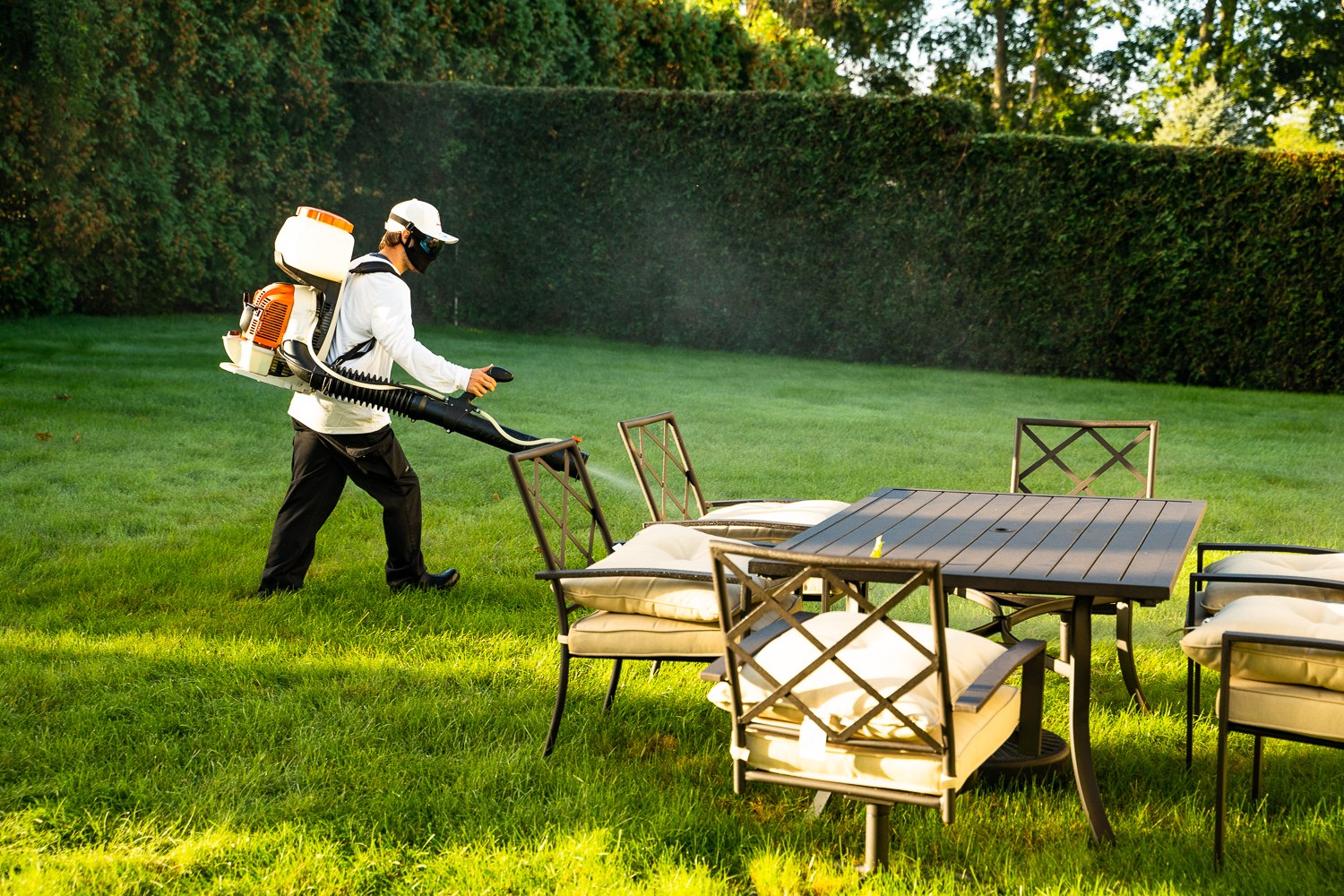
This is what we do, and it is the method I would put first for most yards. A licensed technician walks your property with a backpack mist blower and applies a liquid treatment to the places mosquitoes rest. Our crews start with the perimeter, then treat the bushes, the trees, the pool and deck areas, and around the home, and finish with the lawn. Once the treatment dries on the leaves it keeps working, so a mosquito that lands there later in the week still meets it. Our guide to how barrier spray works and how long it lasts covers the mechanics, and Does Mosquito Spraying Actually Work? covers the research.
The visit is more than the spray. The technician dumps standing water along the way and can place larvicide pucks in water that cannot be dumped, so two stages of the mosquito’s life get attention in one stop. Then we come back, about every two weeks on our standard program, because that is where a single treatment runs out of road.
No treatment lasts forever, and ours does not either. Rain, sun, and new plant growth all wear a barrier spray down, which is the whole reason it is sold as a schedule and not as a one-time fix. It does not put a wall around your yard, either. Mosquitoes hatch next door and fly in, so you will still see one now and then. You can choose between our traditional program and an all-natural one, and the schedule and the guarantee are the same on both.
What you are paying for is consistency and a person. Somebody trained shows up on schedule and looks at what changed since the last visit. And the service is guaranteed. Every one of our plans covers mosquitoes, ticks, and fleas, and if you are getting bitten between visits we come back and respray at no charge. We end up making those extra trips on about 1 percent of the services we complete. Plans and what goes into the cost are on our FAQ page.
Misting Systems
A misting system is the built-in version of spraying. The EPA describes it as a set of spray nozzles mounted around the perimeter of a home, in the landscaping or on the house or fence, connected by tubing to a supply of insecticide. Some run on a timer at preset intervals. Others are switched on by remote. The appeal is obvious: no appointments, and the mist goes off whether you remember it or not.
That last part is also the problem. A timer does not know if it rained an hour ago, if the wind is carrying the mist into the neighbor’s yard, or if the shrubs by the nozzle are in bloom and full of bees. The American Mosquito Control Association, the professional association for the people who run public mosquito control programs, puts it this way: scheduled sprays from these systems “may needlessly broadcast pesticides into the environment, affecting mosquitoes and non-target insects alike.” The EPA is just as direct about the evidence. In its words, outdoor residential misting systems “have not yet been studied sufficiently to document their effectiveness in controlling mosquitoes or other yard and garden pests.”
Source: US EPA — Mosquito Misting Systems
This is where a service visit is different. A person makes the call every time. Our technician looks at the yard that day and decides where the treatment goes and where it does not. Ours skip flowering plants that pollinators feed on, keep a buffer around vegetable gardens, and do not spray into a rainstorm. A nozzle bolted to the fence sprays the same spot on the same schedule all season, no matter what is going on around it.
If you are still considering one, do two things first. Read the EPA page above from top to bottom, and check your state’s rules, because the EPA notes that regulations for these systems vary from state to state and some states restrict them.
Traps and Bug Zappers
These two get lumped together, and they should not be, because the research treats them very differently.
The bug zapper is the easy one. It has been studied, and it does not do the job. The AMCA points to two season-long controlled studies by University of Notre Dame researchers in which mosquitoes made up just 4.1 percent and 6.4 percent of what the zappers killed. Both studies also found no significant difference in the number of mosquitoes in yards with a zapper and yards without one. Most of what a zapper kills is moths, beetles, and other insects that were never going to bite you.
Source: American Mosquito Control Association — Frequently Asked Questions
Mosquito traps are a closer call. These are the machines that give off carbon dioxide, heat, or a scent to imitate a person and then pull mosquitoes into a net or onto a sticky surface. They do catch mosquitoes. The AMCA says they “will trap and kill measurable numbers of mosquitoes,” and then adds the part that matters: whether that produces a reduction you would notice depends on how many mosquitoes you have, how close the breeding water is, the wind, and which species live near you. A full catch bag in the morning feels like proof. It is not the same thing as fewer bites on the deck.
There is one more catch. A trap works by attracting mosquitoes, and the University of Maryland Extension says so in plain terms: traps attract more mosquitoes to an area. If you run one, I would put it well away from where people sit and think of it as a helper for the other things you are doing, not a replacement for them.
The DIY Route: What Is Worth Your Saturday
Some of the best mosquito control you can do costs nothing, and I would tell you to do it even if you never call us.
The first job is water. The CDC’s advice is to go around once a week and empty, scrub, turn over, cover, or throw out anything that holds it: buckets, planters, toys, tarps, birdbaths, the saucer under the flowerpot. For water you cannot dump, like a rain barrel or an ornamental pond, the dunks sold at the hardware store contain Bti, a soil bacterium that the EPA says affects only the larvae of mosquitoes, black flies, and fungus gnats. Dunks will not touch the adults that are already flying, but they stop the next batch.
Source: CDC — Mosquito Control at Home
For the evening itself, two simple things are better than most gadgets. Put a fan on the deck. Mosquitoes are weak fliers, and both the AMCA and Maryland’s extension service recommend moving air where you sit. And wear repellent. The Maryland guidance says to look for DEET, picaridin, or oil of lemon eucalyptus on the label.
After that the returns drop off fast. Citronella candles have what the AMCA calls a mild repellent effect, no better than other candles that give off smoke. The Maryland extension says no plant has been scientifically found to keep mosquitoes away, which is hard news for everybody who bought a “mosquito plant” at the garden center. Ultrasonic repellers are the worst of the bunch. By the AMCA’s count, at least ten studies have found they have no repellent value at all.
Source: University of Maryland Extension — Controlling Mosquitoes
Then there are the store-bought foggers and hose-end yard sprays. They are real insecticide and they do kill the mosquitoes they reach. The Maryland guidance puts the relief from this kind of area spraying at one to three weeks, depending on the chemical and the weather, and points out that it does nothing to stop new mosquitoes from flying in. If you go this way, follow the label to the letter, keep it off anything in bloom, and expect to do it again. A can is fine for the afternoon before a cookout. Doing it properly every few weeks from May to October is a part-time job, and it is the job most people eventually hand to us.
What About Ticks?
If ticks are part of your worry, the list gets short in a hurry. Zappers, traps, candles, and fans are all aimed at insects that fly, and ticks do not fly. They wait in leaf litter, tall grass, and the brushy edge where the lawn meets the woods. Bti dunks only affect larvae living in water. Of the four methods here, a treatment applied to the ground and the edges of the property is the one that actually reaches where ticks live. A store-bought yard spray labeled for ticks can do that too, with the same short life as before. Our Lyme disease prevention guide covers the yard habits that help no matter which way you go.
So Which One Should You Pick?
My recommendation is a professional barrier spray program, and I would give you the same answer if I did not work for one.
Here is why. It is the only option on this list that puts a treatment where mosquitoes rest and keeps it fresh on a schedule. The same visit deals with the standing water. The same plan covers ticks and fleas. A trained person looks at your yard twice a month. And it is the only one that comes with a guarantee: if you are still getting bitten between visits, we come back at no charge. Nothing you can buy in a box does all of that, and the research on barrier treatments backs it up.
The other three do not measure up. A misting system cannot make a judgment call, and the EPA says its effectiveness has not been documented. Bug zappers have been tested and they failed. A trap helps a little at best. The free habits are worth doing in every yard, but they work alongside a treatment, not in place of one.
If your yard backs up to woods or wetland, if the kids and the dog are out there every day, or if ticks are in the picture, I would not wait another summer. The only yard I would tell to hold off is a small deck that gets buggy a few evenings a year. Start with the fan, the repellent, and the weekly water walk, and call us when that stops being enough.
So keep dumping the water, unplug the zapper, and let us handle the rest. This is the work we do every day, and we stand behind it.
Related Reading
- Does Mosquito Spraying Actually Work? — the research behind professional spraying, and its honest limits.
- How Mosquito Barrier Spray Works and How Long It Lasts — what a treatment does on the foliage and what wears it down.
- All-Natural Mosquito Control: What Is in It, How It Works, and What to Expect — the essential-oil program, ingredient by ingredient.
The short answer: for most yards, a professional barrier spray program plus a weekly walk to dump standing water is the combination that works.
Mosquito Mike provides mosquito control across Massachusetts, Rhode Island, and the Raleigh Triangle, with traditional and all-natural programs and complimentary resprays as part of the service guarantee. Get your instant quote.
Frequently Asked Questions
What is the most effective mosquito control for a yard?
For most yards, a recurring professional barrier spray program combined with dumping standing water every week. The EPA describes effective mosquito control as an integrated approach: remove standing water, treat larvae where water cannot be removed, and control the adults. A professional program does all three on one schedule, covers ticks and fleas too, and comes with a respray guarantee. No single gadget covers that much ground.
Are mosquito misting systems worth it?
The evidence is thin. The EPA says outdoor residential misting systems have not yet been studied sufficiently to document their effectiveness in controlling mosquitoes. They release insecticide on a timer whether or not conditions are right, and the American Mosquito Control Association warns that scheduled sprays may needlessly broadcast pesticides and affect non-target insects. Rules for these systems also vary from state to state, so check yours before installing one.
Do bug zappers kill mosquitoes?
A few, but not enough to matter. The American Mosquito Control Association cites two season-long controlled studies by University of Notre Dame researchers in which mosquitoes made up only 4.1 percent and 6.4 percent of the insects zappers killed. Both studies found no significant difference in mosquito numbers between yards with zappers and yards without them. Most of what a zapper kills is moths, beetles, and other insects that do not bite.
Do mosquito traps actually work?
They catch mosquitoes, but that is not the same as fewer bites. The American Mosquito Control Association says traps will trap and kill measurable numbers of mosquitoes, and that whether you notice a reduction depends on the size of the mosquito population, how close the breeding water is, wind, and the species involved. Traps work by attracting mosquitoes, so place one well away from where people sit and use it alongside other measures.
Is professional mosquito spraying better than doing it yourself?
For most yards, yes. A store-bought fogger or hose-end spray does kill the mosquitoes it reaches, but university extension guidance puts the relief at one to three weeks and notes it does not stop new mosquitoes from flying in. A professional program brings commercial equipment, a licensed technician, a repeating schedule, and a respray guarantee. The one exception is a small deck used a few evenings a year, where a fan and repellent may be enough.
Do citronella candles and mosquito-repelling plants work?
Not well. The American Mosquito Control Association says citronella candles have a mild repellent effect, no better than other candles that produce smoke. The University of Maryland Extension says no plants have been scientifically found to keep mosquitoes away. Ultrasonic repellers do worse still: by the association’s count, at least ten studies found no repellent value at all. A fan on the deck and a repellent with DEET, picaridin, or oil of lemon eucalyptus are better bets.
What can I do about mosquitoes for free?
Start with water. The CDC recommends going around once a week to empty, scrub, turn over, cover, or throw out anything that holds water, such as buckets, planters, toys, and birdbaths. Keep gutters flowing and screens in good repair. In the evening, run a fan where you sit, since mosquitoes are weak fliers. For water you cannot dump, such as a rain barrel, Bti dunks from the hardware store stop mosquito larvae from becoming adults.
Which mosquito control methods also work on ticks?
Very few. Zappers, traps, candles, and fans target flying insects, and ticks do not fly. They wait in leaf litter, tall grass, and brushy edges. Bti dunks only affect larvae living in water. A treatment applied to the ground and the edges of the property reaches where ticks live, which is why every Mosquito Mike plan covers mosquitoes, ticks, and fleas together. A store-bought yard spray labeled for ticks can also reach them, for a shorter time.
Ready to take your yard back?
Get an instant quote for your property in about a minute.
Get Your Free QuoteOr call (844) 750-6453

Ready to take your yard back?
Get an instant quote for your property in about a minute.