
Tick Season in Massachusetts: When Ticks Are Active and How to Protect Your Yard
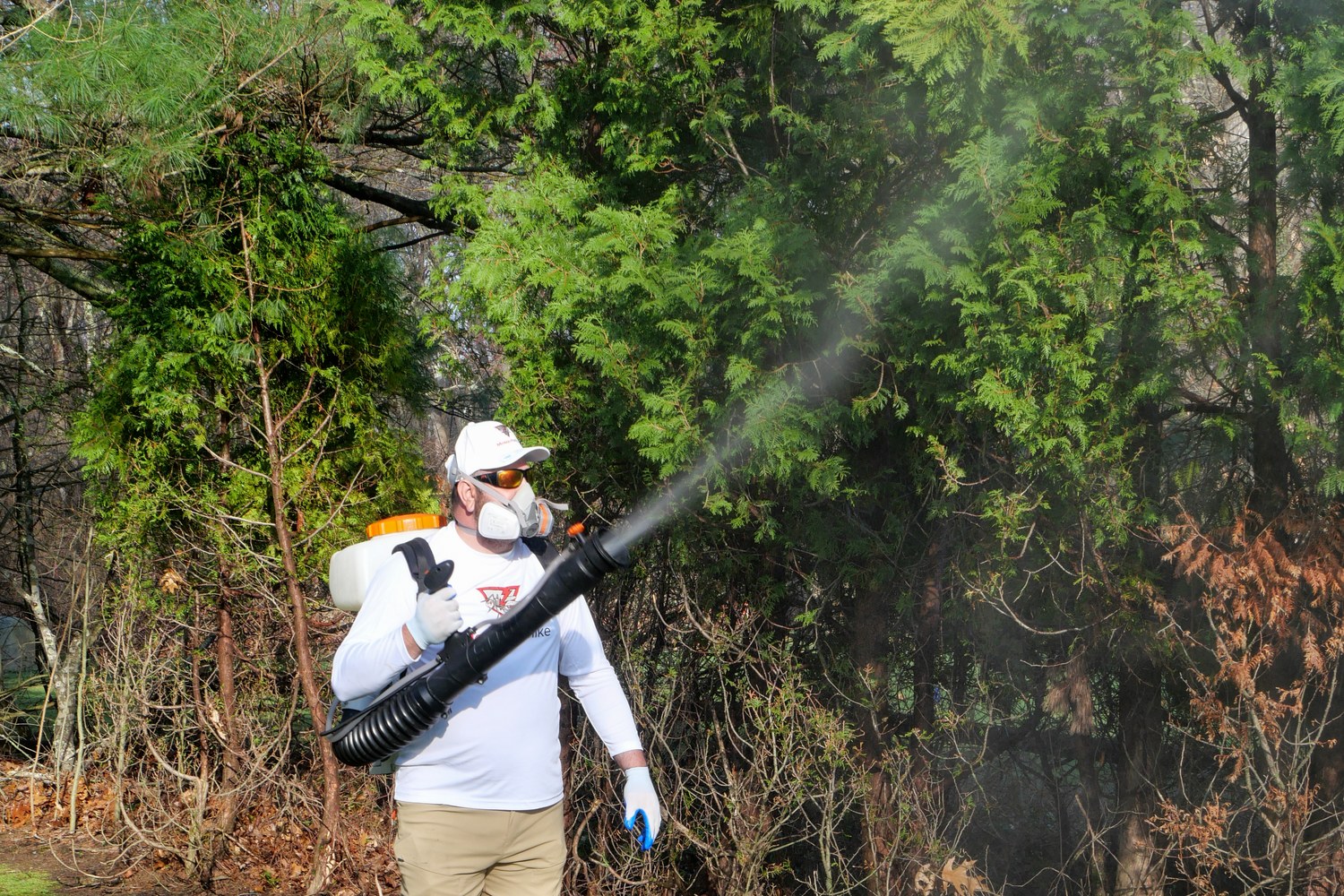
If you live in Massachusetts or Rhode Island, tick season is not a summer problem you can plan around. It is a year-round condition with two sharp peaks, and the single most useful fact about it is one most homeowners have never been told: deer ticks do not need warm weather to bite you. They need the ground to be thawed and the air to be above freezing.
This guide covers when ticks are active month by month, which four species you are actually likely to meet here, where they concentrate on a typical New England property, and how professional tick treatment is timed. For Lyme disease specifically — transmission, symptoms, what to do after a bite, and prevention in the Raleigh Triangle as well as New England — see our companion guide to Lyme disease prevention for homeowners.
When Is Tick Season in Massachusetts? Year-Round, With Two Peaks
The Massachusetts Department of Public Health is direct about this. On its tick-borne disease prevention page, describing adult deer ticks:
Adults can also be out searching for a host any time winter temperatures are above freezing
Source: Massachusetts Department of Public Health — Tick-borne Disease Prevention
The University of Rhode Island reaches the same conclusion independently. Its TickEncounter Resource Center reports that adult blacklegged ticks are active October through May as long as the daytime temperature stays above freezing, and that the two conditions that matter are thawed ground and an air temperature above 32 degrees. Ticks sitting on frozen ground simply cannot move their muscles; the moment that changes, they can resume questing, even for a day or two mid-winter.
Source: URI TickEncounter Resource Center — Winter Tick Activity
So there is no off season here. What there is, is a rhythm. Risk peaks twice: once from mid-May through midsummer, when nymph-stage deer ticks are questing, and again in fall when adults come out, with a secondary adult push in early spring. The Connecticut Agricultural Experiment Station puts the nymph window plainly — the optimum time to treat for nymphal deer ticks is mid-May to early June, before the population peaks.
A Month-by-Month Tick Calendar for Massachusetts and Rhode Island
January and February. Adult deer ticks are out on any day the ground is thawed and the air is above freezing, which in a New England winter is a normal week, not a freak event. Overall numbers questing are low. Immature ticks that have not yet fed are overwintering in the leaf litter.
March and April. Overwintered adults resume host-seeking in earnest as the ground thaws for good. This is the year’s first sustained risk window, and it lands exactly when people start doing yard cleanup — raking, edging, clearing brush — in the habitat where ticks live.
May and June. Nymph season. These are last year’s larvae: they took a blood meal, molted to the nymph stage, overwintered, and are now questing. They are about 1.3 to 1.7 millimetres, roughly pinhead-sized, and their bite is painless. This is the highest-risk window of the year in southern New England, and it is the window professional nymph treatments are timed to.
July. Nymph activity continues, concentrated in cooler, shaded, wooded parts of a property. Adult activity is at its low point.
August and September. Nymph pressure tapers. American dog tick adults have been out since late April and are winding down. Adult deer ticks begin to appear as the season turns.
October and November. The second peak. Adult deer ticks quest for large hosts, primarily white-tailed deer, which are their reproductive host. Adults are larger and easier to find than nymphs, which is why they cause proportionally fewer Lyme cases despite carrying infection at higher rates.
December. Activity drops but does not stop. Leaf litter and snow cover insulate the ground layer, and any thaw brings adults back to the tips of low vegetation.
Source: Connecticut Agricultural Experiment Station — Tick Management Handbook
The Four Ticks You Are Likely to Meet in MA and RI
Blacklegged tick, also called the deer tick (Ixodes scapularis). The one that matters most here. It transmits Lyme disease, anaplasmosis, babesiosis, Powassan virus in its deer tick virus form, and hard tick relapsing fever. It runs a two-year life cycle through four stages — egg, six-legged larva, nymph, adult — and each active stage takes one blood meal before molting to the next. Larvae feed largely on small mammals such as white-footed mice, which are the main reservoir for the Lyme bacterium in New England. It is found mainly in deciduous woodland and in the tall grass and shrubs bordering forest edges.
American dog tick (Dermacentor variabilis). The big brown-and-white-marbled tick most people here grew up recognizing. Adults are active from April into early August and are common along forest edges, grassy fields, walkways and trails. An engorged female runs about 13 millimetres long by 10 wide and looks like a dark pinto bean. It transmits Rocky Mountain spotted fever and tularemia. It does not transmit Lyme disease.
Lone star tick (Amblyomma americanum). Historically a southeastern species, now moving north. Adults are reddish brown and about 3 to 4 millimetres, and the female carries a single white dot on her back. It transmits ehrlichiosis, tularemia, STARI, Heartland and Bourbon virus disease, and it is the tick associated with alpha-gal syndrome, the red-meat allergy. Two things make it distinctive: it is an aggressive human biter that moves toward hosts rather than waiting, and it is genuinely establishing here. A 2024 study tracked 1,265 yard surveys on Martha’s Vineyard from 2011 to 2024 and documented lone star ticks breeding on Chappaquiddick and in Aquinnah by 2015, then surging across the island from about 2016 to 2019. In Rhode Island, records were long confined largely to Prudence Island, with newer sightings elsewhere.
Woodchuck tick, also called the groundhog tick (Ixodes cookei). Found throughout the eastern states, feeding mostly on woodchucks, skunks and other medium-sized mammals. It is a poor vector for the Lyme bacterium, and it is the principal vector of Powassan virus lineage 1. Here is the correction worth making, because it is commonly got backwards: Ixodes cookei rarely bites people. The Rhode Island Department of Health notes that it is the deer tick, carrying the lineage 2 form known as deer tick virus, that often bites humans. Powassan remains rare — RI DOH cites 75 US cases over a ten-year span — but the tick to watch for it is the same deer tick you are already watching for.
Source: Rhode Island Department of Health — Powassan
Why Nymphs Cause Most of the Trouble
Adult deer ticks are more likely to be infected than nymphs. Nymphs still cause almost all the disease. The Connecticut Agricultural Experiment Station puts it at about 98% of Lyme cases associated with a nymphal bite, from a nymph population of which roughly 10 to 36% may be carrying Lyme spirochetes.
The reason is detection, not biology. A nymph is about the size of a pinhead, its bite is painless, and its season overlaps with the months people spend outside. An adult tick is large enough to find and pull off before it matters.
Timing is what makes that survivable. It takes 36 to 48 hours or more of attachment for the Lyme bacterium to be transmitted, and not every tick is infected. That window is the whole argument for a daily tick check: a tick found and removed the same evening is a very different event from one found three days later.
Source: Rhode Island Department of Health — Lyme Disease
One more figure from the same handbook reframes where the risk actually is. About 75% of Lyme cases are associated with ordinary activity around the home — play, yard work, gardening. Not hiking. Not the deep woods. Your own property.
That last figure is the argument for treating a yard at all. The exposure is not concentrated somewhere you visit occasionally; it is in the part of your property you use most, in the months you use it. A residential tick application is aimed at that, and nothing else.
Can Ticks Survive a New England Winter?
Yes, and the mechanism is worth understanding because it changes what you do in November.
Deer tick adults are not killed by freezing temperatures. What stops them is being frozen in place or buried under snow, and both conditions are temporary. Meanwhile the immature stages are riding out the winter in the leaf litter, and the leaf litter is protecting them. A three-winter field study across Connecticut and Maine found that nymphs in plots where leaf litter and snow were left alone survived at 54 to 94%, while nymphs in plots where both leaf litter and snow were stripped away survived at 31 to 77%. The authors’ management conclusion is explicit: removing that protective leaf layer is a practical way for homeowners to reduce tick overwintering survival.
So a mild winter is not good news. It means more days above freezing with thawed ground, which means more adult questing days. And a yard left deep in unraked leaves is a yard that carries more of its tick population through to spring.
Where Ticks Actually Are on Your Property
This is the part most yard advice gets vague about, and there is no need to. Sampling across residential properties gives a clear distribution: about 67% of blacklegged ticks are in densely wooded areas, 22% in the ecotone — the unmaintained transitional edge between woods and open ground — 9% in ornamental vegetation, and 2% on the lawn itself.
And within that lawn 2%, position matters enormously: 82% of those ticks sit within three yards of the lawn perimeter, particularly along woodlands, stone walls, or ornamental plantings.
Translated into a walk around your own yard, the high-risk zones are:
- The treeline. Where mowed lawn meets woods or brush. Deer travel it, mice nest in it, and ticks quest at the tips of low vegetation along it.
- Stone walls. Classic New England, and classic white-footed mouse habitat — shaded walls overgrown with grass and leaf litter are the worst case.
- Leaf litter. Along fences, around foundation plantings, under decks. Overwintering habitat and moisture reservoir in one.
- Dense groundcover. Pachysandra, English ivy and similar plantings hold the cool, humid microclimate ticks need, and they are often planted right where people walk.
- Brush piles and woodpiles. Rodent habitat, and rodents are how infected ticks arrive.
The sunny, mowed, open middle of the lawn is the one place ticks are genuinely scarce.
Source: Connecticut Agricultural Experiment Station — Tick Management Handbook
That distribution is also the treatment map. Our application covers the full property — open lawn included — with the heaviest attention on the wooded ground and the unmaintained edge, where nearly nine in ten of the ticks are, along the stone walls and ornamental plantings, and across the three-yard band where lawn meets all of it.
What Actually Reduces Ticks in a Yard
Habitat changes, in rough order of return:
- Remove leaf litter at the lawn perimeter and against structures. This is the one with peer-reviewed backing behind it — see the overwintering study above.
- Put a wood chip, mulch or gravel border between lawn and woods or stone walls. Three feet wide or better. Honest caveat from the source: results vary widely between properties and between years, and a barrier that degrades into leaf mulch stops being a barrier, so it needs refreshing.
- Mow, and keep the sunny middle sunny. Ticks desiccate in open sun.
- Move woodpiles and brush piles away from the house and play areas, and keep stone walls near the house clear of brush, high grass and leaf litter to discourage mice.
- Reconsider groundcover beds next to walkways, patios and play areas.
- Keep play equipment, decks and patios away from the yard edge and out of shade.
Personal protection, which is not optional even in a treated yard:
- EPA-registered repellents on skin: DEET, picaridin, IR3535, or oil of lemon eucalyptus. DEET is effective for one to several hours and needs reapplying.
- Permethrin on clothing and gear only, never skin. Consumer products for treating clothing contain 0.5% permethrin.
- Light-coloured clothing, long sleeves, pants tucked into socks in brush.
- Check for ticks as soon as you come indoors, and shower soon after. Check the scalp and hairline, behind the ears, underarms, waistband, navel, groin and behind the knees.
- Dry your clothes properly. Blacklegged and lone star ticks can survive a warm or hot water wash. They cannot survive an hour in a hot dryer. Ten minutes is the number people repeat; an hour is the number the research supports.
- Check pets before they come inside.
Protect your yard before the nymphs are out.
Mosquito Mike provides professional tick control across Massachusetts and Rhode Island, from Fall River to Lowell. Get a free quote today.
If You Find an Attached Tick
Short version here; the full post-bite walkthrough, including when to contact a provider, is in our Lyme disease prevention guide.
- Use fine-tipped tweezers. Grasp the tick as close to the skin surface as you can.
- Pull straight up with steady, even pressure. Do not twist or jerk — mouthparts can break off in the skin.
- Clean the bite area and your hands with rubbing alcohol or soap and water.
- Dispose of the tick in alcohol, in a sealed bag, or by flushing it. Do not crush it with your fingers.
- Note the date. If you can, keep the tick in a sealed bag.
Skip the folk remedies — petroleum jelly, nail polish, a hot match. They do not work and they waste the hours that matter.
This is general information, not medical advice. If you develop any symptoms after a tick bite, or you are simply unsure about an exposure, contact a licensed healthcare provider promptly. Only a clinician can evaluate and diagnose a tick-related illness.
How Professional Tick Control Is Timed
Tick control is a timing problem, not a frequency problem. That distinction is the single most important thing to understand before buying it, and it is where most marketing in this category goes wrong.
The evidence is consistent. The Connecticut Agricultural Experiment Station states that the optimum application for nymphal deer ticks is mid-May to early June, that a single application of most acaricides is sufficient for the summer tick season, and that a fall application handles adult Ixodes scapularis, with an early spring application if no fall treatment was made. The University of Maine Cooperative Extension gives the same two windows. And CDC-published research on product efficacy found that a bifenthrin product provided 100% suppression of nymphal blacklegged ticks for nine weeks after a single spray event, with synthetic pyrethroids suppressing host-seeking blacklegged ticks for at least six weeks.
Source: University of Maine Cooperative Extension Tick Lab — Chemical Control
So a well-built tick program is a small number of correctly timed applications — generally two to four across the year — timed to the life cycle and weighted toward where the ticks are:
- Late fall or early spring: target adults.
- Mid-May to early June: target nymphs, ahead of the peak.
- Fall: target the second adult wave.
- Through the winter: our winter tick control program runs November through March on its own schedule, because adults keep questing on every above-freezing day.
We treat the entire property — the open lawn as well as the perimeter — working hardest at the woodland edge, several yards into bordering woods, stone walls, groundcover beds, ornamental plantings, and the borders of the areas people actually use, because that is where the ticks concentrate.
What we apply. Our traditional tick treatment uses bifenthrin — a synthetic version of compounds found in chrysanthemum flowers — combined with garlic and a sticking agent that helps the material stay on foliage. Our all-natural option is a minimum-risk formula built on citronella, peppermint, and cinnamon oils, also with garlic and a sticking agent.
And the honest limit: a yard treatment reduces ticks in the yard; it does not replace the tick check. In a CDC-funded trial, a single springtime acaricide application cut tick numbers on treated properties by 63% — a real reduction, from one spray. One spray is not a program: ticks are active from early spring through late fall, which is why we treat through the season rather than once — and why the habits (daily checks, treated clothing, the dryer) still matter.
One clarification, since we get asked: our mosquito plans run on a regular treatment interval because mosquito pressure rebuilds continuously through the season. Tick work does not follow the mosquito calendar. It follows the tick life cycle.
Lyme Disease in Massachusetts: What the Data Supports
Lyme disease is endemic in Massachusetts, and the reported case count understates it. Research published in the CDC journal Emerging Infectious Diseases, working from Massachusetts electronic health records, notes that traditional surveillance has been burdensome and incomplete and that insurance-claims analysis suggests true incidence may be six- to eight-fold higher than what is reported to public health agencies. Mapping the cases it identified, the study found them clustered in neighbourhoods north and south of Boston and on Cape Cod and the surrounding islands — consistent with the historic distribution of the disease in the state.
Why here? Dense second-growth woodland pressed up against residential neighbourhoods, high white-tailed deer numbers sustaining the adult tick population, abundant white-footed mice serving as the reservoir, and a climate that keeps adult ticks in play most of the year.
The practical read is narrower than the headline: the risk is concentrated at the edges of your own property, in a stage of tick you can barely see, during months you are outside anyway. All three of those are addressable.
Mosquito Mike serves homeowners across Massachusetts and Rhode Island, including the Cape, the South Shore and coastal Rhode Island. Get a free quote today.
This article is for general educational purposes only. It does not constitute medical advice. If you have concerns about a tick bite, symptoms, or tick-borne disease, consult a licensed healthcare provider.
Frequently Asked Questions
When is tick season in Massachusetts?
There is no off season. The Massachusetts Department of Public Health states that adult deer ticks can search for a host any time winter temperatures are above freezing, and the URI TickEncounter Resource Center reports adults active October through May whenever the ground is thawed and the temperature is above freezing. Risk peaks twice: mid-May through midsummer for nymphs, and fall for adults, with a second adult push in early spring.
Are ticks active in Massachusetts during the winter?
Yes. Freezing temperatures do not kill adult deer ticks. They stop moving when the ground is frozen or they are buried under snow, and they resume host seeking whenever the ground thaws and the air rises above freezing, which happens regularly in a New England winter. Immature ticks overwinter in leaf litter, which insulates them. A mild winter means more questing days, not fewer ticks.
What kinds of ticks live in Massachusetts and Rhode Island?
Four species account for nearly all human encounters. The blacklegged tick, or deer tick, transmits Lyme disease, anaplasmosis, babesiosis and Powassan virus. The American dog tick transmits Rocky Mountain spotted fever and tularemia but not Lyme disease. The lone star tick transmits ehrlichiosis and STARI and is linked to alpha-gal syndrome. The woodchuck tick feeds mainly on wildlife and rarely bites people.
Why are nymph ticks more dangerous than adult ticks?
Adult deer ticks carry infection at higher rates, but nymphs cause almost all the disease. The Connecticut Agricultural Experiment Station associates about 98 percent of Lyme cases with a nymphal bite. A nymph is roughly the size of a pinhead, about 1.3 to 1.7 millimetres, and its bite is painless, so it is easy to miss for days. Adults are large enough that most people find and remove them in time.
Where do ticks hide in a Massachusetts yard?
Mostly at the edges. Sampling on residential properties puts about 67 percent of blacklegged ticks in dense woods, 22 percent in the unmaintained edge between woods and lawn, 9 percent in ornamental plantings and 2 percent on the lawn itself. Of the ticks found on lawn, 82 percent sit within three yards of the perimeter, especially along woodlands, stone walls and ornamental beds. Open sunny lawn is the safest ground.
Are lone star ticks in Massachusetts and Rhode Island now?
Yes, and they are spreading. A 2024 study of 1,265 yard surveys on a coastal Massachusetts island documented lone star ticks breeding at Chappaquiddick and Aquinnah by 2015, followed by a surge across the island between roughly 2016 and 2019. In Rhode Island, records were long concentrated on Prudence Island, with newer sightings elsewhere. Lone star ticks are aggressive human biters and are linked to the red meat allergy called alpha-gal syndrome.
When should a yard be treated for ticks?
Tick treatment is timed, not scheduled at a fixed interval. The Connecticut Agricultural Experiment Station puts the optimum nymph application at mid-May to early June and adds that a single application is generally sufficient for the summer tick season, with a fall application for adults or an early spring one if fall was missed. Most properties are well served by two to four correctly timed applications a year, covering the whole property with extra attention on the woodland edge.
Does raking leaves actually reduce ticks?
Yes, and it is one of the few homeowner measures with direct field evidence behind it. A three winter study in Connecticut and Maine found nymphal deer ticks survived at 54 to 94 percent where leaf litter and snow were left undisturbed, but only 31 to 77 percent where both were removed. The authors recommend removing leaf litter as a practical landscape change. Focus on the lawn perimeter, foundation plantings and under decks.
Ready to take your yard back?
Get an instant quote for your property in about a minute.
Get Your Free QuoteOr call (844) 750-6453

Ready to take your yard back?
Get an instant quote for your property in about a minute.